1. “President Trump received more votes than any previous incumbent seeking reelection. He got 11 million more votes than in 2016, the third largest rise in support ever for an incumbent.”
2. “Trump’s vote increased so much because, according to exit polls, he performed far better with many key demographic groups. Ninety-five percent of Republicans voted for him.”
3. “He earned the highest share of all minority votes for a Republican since 1960. Trump grew his support among black voters by 50 percent over 2016… Joe Biden’s black support fell well below 90 percent, the level below which Democratic presidential candidates usually lose.”
4. “Trump increased his share of the national Hispanic vote to 35 percent. With 60 percent or less of the national Hispanic vote, it is arithmetically impossible for a Democratic presidential candidate to win Florida, Arizona, Nevada, and New Mexico.”
5. “Bellwether states swung further in Trump’s direction than in 2016. Florida, Ohio and Iowa each defied America’s media polls with huge wins for Trump. Since 1852, only Richard Nixon has lost the electoral college after winning this trio”…
6. “Midwestern states Michigan, Pennsylvania, and Wisconsin always swing in the same direction as Ohio and Iowa, their regional peers. Ohio likewise swings with Florida. Current tallies show that, outside of a few cities, the Rust Belt swung in Trump’s direction.”
7. “Yet, Biden leads in Michigan, Pennsylvania, and Wisconsin because of an apparent avalanche of black votes in Detroit, Philadelphia, and Milwaukee. Biden’s ‘winning’ margin was derived almost entirely from such voters in these cities”…
8. “… as coincidentally his black vote spiked only in exactly the locations necessary to secure victory. He did not receive comparable levels of support among comparable demographic groups in comparable states, which is highly unusual for the presidential victor.”
9. “We are told that Biden won more votes nationally than any presidential candidate in history. But he won a record low of 17 percent of counties; he only won 524 counties, as opposed to the 873 counties Obama won in 2008. Yet, Biden somehow outdid Obama in total votes.”
10. “Victorious presidential candidates, especially challengers, usually have down-ballot coattails; Biden did not. The Republicans held the Senate and enjoyed a ‘red wave’ in the House, where they gained a large number of seats while winning all 27 toss-up contests.”
11. “Trump’s party did not lose a single state legislature and actually made gains at the state level.”
12. “Another anomaly is found in the comparison between the polls and non-polling metrics. The latter include: party registrations trends; candidates’ respective primary votes; candidate enthusiasm; social media followings; broadcast and digital media ratings; online searches”…
What is the probability P that Covid-19 would spread among several dozen leading Democrats and Biden officials after a dinner hosted by the Gridiron Club, where PROOF OF VACCINE WAS REQUIRED?
P= 1/trillion*trillion*trillion*trillion*trillion
Assume N=100 at dinner, n= 24 infected, R= 2% infection rate, T=1 week= .019 year
On Dec.1, 2021, the 7-day average of number of cases was 52,000 and the 7-day average mortality rate (total deaths/total cases) was 1.1%.
As of Dec. 31, the corresponding averages were 367,000 and 0.31%. The number of daily cases has increased by 7X while the number of daily deaths is nearly constant (1100). Did you hear this on CNN, MSNBC or FOX? Of course not. Ask yourself why.
Are the cases inflated by Omicron (which has virtually zero mortality) and/or false positive tests? How many of the deaths were vaccinated? Does the declining death rate reflect herd immunity and/or the use of Ivermectin, Regeneron and HCQ?
This is the biggest con-job in history. The unvaccinated are not spreading Covid. The problem is vaccinated taking boosters with spiked protein affecting their DNA and possibly spreading Covid to the unvaccinated. https://docs.google.com/…/1Jbfznj3c27kKvF7Vpo9pWIe…/edit
Probability analysis: 24 Unadjusted state exit polls vs. recorded vote vs. Cyber Symposium PCAPS.
The deviations are far beyond the state exit poll margin of error. They cannot be explained as being due to chance. Trust the Cyber symposium votes. The unadjusted exit poll and recorded votes are bogus.
N= number of the 24 states exit polled in which the margin of error was exceeded (only 1-2 would be expected at the 95% confidence level)
Vote discrepancy: n=Number of states; Probability P=poisson (n,0.025*24,false)
Exit vs recorded: n=8; P= 1 in 4.4 million
Cyber vs recorded: n=14; P= 1 in 202 trillion
Exit v Cyber: n=15; P= 1 in 5000 trillion
Exit Poll flip: n=24; P = 1 in 16.8 million; P=binomdist (24,24,0.5,false)
Trump had 44.9% in the 24 state exit poll weighted average and 50.3% in the corresponding Cyber average. The probability of the deviation assuming a 1.5% margin of error is P= 1 in 264 million.
P=normdist ( 0.449,0.503,0.0155/1.96,false) =1/264 million
Trump’s racial shares are forced to match the Cyber Symposium PCAPS using the 2020 Census state votes for each racial group. The sensitivity analysis consists of 25 scenarios over a range of Trump shares of white and black voters.
For example, to match the AZ Cyber Symposium vote, Trump had 61% of whites, 13% of blacks, 44% of Hispanics, 34% of Asians and 41% of Others and had a 270,000 base case vote margin. The worst case margin is 79,000. The best case is 460,000. Biden “won” the rigged AZ election by 10,500 votes.
Biden won the 24 unadjusted state exit polls by 52.6-44.9% and the national vote by 51.3-46.9%.
Trump won the corresponding 24 state Cyber vote by 50.3-47.9%; The exit poll margin of error was exceeded in15 states .
Probability P = 1 in 64 million that Trump would have 44.9% in the 24 unadjusted state exit poll aggregate (1.55% MoE) and 50.3% in the Cyber vote: P= normdist (.503, .449, 1.55%/1.96, True)
Probability P = 1 in 16.7 million that 24 states would move to Trump in the Cyber vote from the unadjusted exit poll: P= binomdist (24, 24, 0.5, false)
Unadjusted exit polls have always been adjusted in published final polls to match the recorded vote. The exit pollsters at Edison Research claimed they do this because their polls were wrong; they assume the vote counts were accurate. But the pollsters never considered or noted that election fraud was a major factor in the discrepancies. And the corrupt media and politicians maintain the myth that election fraud is a non-existent conspiracy theory.
But mathematical analysts are not fooled. The unadjusted 2000 and 2004 exit polls were fairly accurate and close to the True Vote. Gore and Kerry won easily. The polls proved to be excellent indicators of election fraud. But starting in 2016, the polls have been rigged to match the bogus popular vote.
Let’s compare the Cyber Symposium PCAP votes to the unadjusted exit polls and recorded votes. In the 24 states polled in 2020, Trump’s weighted average PCAPS vote share was 50.3%. He had a 44.9% unadjusted exit poll share and a 46.2% reported share. Trump’s Cyber shares were higher than the exit poll and reported shares in every state.
Bottom line: Don’t trust unadjusted exit polls. They are no different from biased pre-election polls which are just propaganda to set false expectations and influence the public.
Trump won the final Pennsylvania Exit Poll Race category by 10,000 votes (even though it grossly understated his shares of whites, blacks and Hispanics). Biden won the Party-ID category by 103,000 (understating Trump’s shares of Republicans and Independents). The Dems rigged the election and Biden “won” PA by 81,000 votes.
But Trump won PA in a 495,000 vote landslide according to the Cyber Symposium (PCAPS). I used Census race weights and adjusted the vote shares to match the Cyber vote.
The Cyber Symposium state results and the 2020 RACE vote census refute the bogus recorded votes of 24 state race exit polls and 26 other states. The race vote shares are forced to match the Cyber margins.
Most of the fraud was in White vote shares , but also in shares of Blacks and Hispanics. Note the difference in the state reported vote margin and Cyber margin.
View all Cyber Symposium stats, Census race breakdowns and bogus reported/exit poll vote tables.
National Exit Poll – forced to match reported vote
US Exit Poll
Pct
Trump
Biden
Other
Margin
White
67%
58%
41%
1%
Black
13%
12%
87%
1%
Hispanic
13%
32%
65%
3%
Asian
4%
34%
61%
5%
Other
3%
41%
55%
4%
Calc
100%
47.17%
51.32%
1.51%
-4.15%
Reported
158,384
46.86%
51.31%
1.83%
-4.45%
Reported
158,384
74,217
81,269
2,898
-7,052
National vote (adjust Trump white vote share to match Cyber)
The CO Exit Poll was forced to match the recorded vote Biden (55.4-41.9%). How did Biden get 57% of whites in CO if Trump had 58% nationally? For the poll to match the recorded vote, CO Exit Poll vote shares had to be INCREASED for Trump! The sensitivity analysis below shows that Trump would have won CO if he had just 51% of the white vote.
Note that the Census indicates 2,827,000 voted in CO compared to the 3,256,000 reported. Could there have been an estimated 430,000 STUFFED BALLOTS? Where is the CO Forensic audit?
National Exit Poll – adjusted to match the total U.S. reported vote
NEP
Pct
Trump
Biden
Other
White
67%
58%
41%
1%
Black
13%
12%
87%
1%
Hispanic
13%
32%
65%
3%
Asian
4%
34%
61%
5%
Other
3%
41%
55%
4%
Reported
100%
47.17%
51.32%
1.51%
CO Exit Poll – adjusted to match the CO reported vote. Biden wins by 440,000 votes
CO
Pct
Trump
Biden
Other
White
79%
41%
57%
2%
Black
3%
16%
80%
4%
Hispanic
12%
49%
47%
4%
Asian
2%
53%
42%
5%
Other
4%
53%
38%
9%
Total
100%
41.9%
55.4%
2.7%
Reported
100%
41.9%
55.4%
2.7%
Votes
3,256
1,364
1,804
88
National Exit Poll vote shares and CO Census voting weights. Trump wins by 212,000 votes.
CO
Census
Census
NEP
NEP
NEP
Adjust
Votes
Pct
Trump
Biden
Other
White
2,316
81.6%
58%
41%
1%
Black
96
3.4%
12%
87%
1%
Hispanic
315
11.1%
32%
65%
3%
Asian
50
1.8%
34%
61%
5%
Other
60
2.1%
41%
55%
4%
Total
2,837
100.0%
53.0%
45.5%
1.5%
Reported
3,256
100.0%
41.9%
55.4%
2.7%
Census Votes
2837
1503
1291
44
Sensitivity Analysis – Trump wins by 31,000 with 51% of the white vote
% Hispanic
CO
Trump
% White
43%
43%
45%
47%
49%
51%
% Black
Margin
29%
-377
-271
-164
-58
48
27%
-381
-275
-169
-62
44
25%
-386
-280
-173
-67
40
23%
-390
-284
-178
-71
35
21%
-395
-288
-182
-76
31
Trump
29%
42.9%
44.5%
46.1%
47.8%
49.4%
27%
42.8%
44.4%
46.1%
47.7%
49.3%
25%
42.7%
44.4%
46.0%
47.6%
49.3%
23%
42.7%
44.3%
45.9%
47.6%
49.2%
21%
42.6%
44.2%
45.9%
47.5%
49.1%
Biden
29%
54.4%
52.8%
51.2%
49.5%
47.9%
27%
54.5%
52.9%
51.2%
49.6%
48.0%
25%
54.6%
52.9%
51.3%
49.7%
48.0%
23%
54.6%
53.0%
51.4%
49.7%
48.1%
21%
54.7%
53.1%
51.4%
49.8%
48.2%
Votes
Trump
29%
1,396
1,449
1,502
1,556
1,609
27%
1,394
1,447
1,500
1,553
1,606
25%
1,392
1,445
1,498
1,551
1,604
23%
1,389
1,443
1,496
1,549
1,602
21%
1,387
1,440
1,494
1,547
1,600
Votes
Biden
29%
1,773
1,720
1,667
1,613
1,560
27%
1,775
1,722
1,669
1,616
1,563
25%
1,777
1,724
1,671
1,618
1,565
23%
1,780
1,726
1,673
1,620
1,567
21%
1,782
1,729
1,675
1,622
1,569
2020 Census Table 4b. Reported Voting and Registration, by Sex, Race and Hispanic Origin, for States: November 2020
This will show proof that CNN and Fox News think you’re stupid.
On Sept. 7, CNN had 49% Biden approval. On Oct. 13, after the sharp decline in Biden’s overall approval, CNN showed 50%! On Sept. 15, Fox showed 50%. On Sept. 11, The Hill had 54%. WTF!
Reuters/Ipsos (Oct. 14) is another establishment poll which is always biased. It has Biden at 47%, with 15% approval from Republicans! Compare it to Quinnipiac’s 3%.
The Oct. 18 Quinnipiac poll has Biden approval at 37% (see below).
Civiqs is an online national and state demographic survey. Biden is at 39% (see trend below).
We have the latest CNN internals. As usual, CNN underweighted the percent of Republican respondents and manipulated the poll shares to derive the bogus approval rating. All unbiased (and biased) observers should know by now that it is standard operating procedure for the media to rig pre-election and exit polls for the Democrats. For those that still don’t see this: wake up and do the math!
The following steps show how CNN may have derived 50% Biden approval, given the average current 43% Biden approval rating.
Step 1: Start with the consensus Biden approval using 2020 National Exit Poll Party-ID
If a state’s Census votes are LESS than recorded, assume the difference is due to NET STUFFED ballots. If the Census votes are GREATER than recorded, assume the difference is due to NET LOST/DISCARDED ballots. In the US, there were 3.7 million net stuffed ballots (5.9 million net stuffed in 33 states and 2.2 million net lost in18 states).
Note that if the Census vote is close to the Reported vote in a state (i.e. the net absolute difference is less than 2%), then we can assume that the number of stuffed ballots is close to the number of lost/discarded ballots.
These states had the most net stuffed ballots (Diff). Note that the net differences exceeded the margin of error, therefore there is a virtual ZERO probability that the discrepancies were due to chance.
Stuffed ballots (net)
Census
Recorded
Diff
Diff %
MoE %
US (000)
154,628
158,384
3,756
2.4%
0.4
Florida
9,720
11,067
1,347
12.2%
1.6
North Carolina
4,780
5,525
745
13.5%
2.3
California
16,893
17,501
608
3.5%
1.2
Michigan
4,994
5,539
545
9.8%
2.2
Colorado
2,837
3,257
420
12.9%
3
Massachusetts
3,249
3,631
382
10.5%
2.7
Washington
3,854
4,088
234
5.7%
2.5
Virginia
4,275
4,461
186
4.2%
2.4
Pennsylvania
6,756
6,915
159
2.3%
1.9
Connecticut
1,681
1,824
143
7.9%
3.4
Georgia
4,888
5,000
112
2.2%
2.3
These states had the most net lost/discarded ballots. Each net abs (Diff) exceeded the Census margin of error, a virtual ZERO probability that the discrepancies were due to chance.
The 2020 census reported 154.628 million voted. The margin of error was 0.4%. There was a 90% level of confidence that there were 154.009m-155.247m votes (+/- 618,520 votes from the Census).
There were 158.38m recorded votes, exceeding the census by 3.8 million, far above the 618,520 Census margin of error. Where did those excess votes come from?
Also, according to the Census, white voters comprised 71% of the vote. According to the NEP, they were 67% of the electorate and Trump had 58% of whites. Applying the 3.8 million (4%) increase of white voters in the census over the NEP reduces Biden’s margin by more than half (4.46% to 2.04%). But it does not take into account forced reduction in Trump’s true vote shares required to match the proven fraudulent recorded vote.
As always, the NEP forced a near perfect match to the reported vote; the anomalies understate Trump’s True vote. He won in a landslide. It will become obvious when battleground states have forensic audits.
In 1992-2012, exit pollsters at Edison Research conducted unadjusted exit polls that were fairly accurate and close to the True Vote. But they always adjust (force) the unadjusted polls to match the reported vote. Clinton, Gore, Kerry and Obama all won the state and national unadjusted exit polls. But since the 2000 and 2004 elections were stolen, the polls were forced to match the bogus reported votes.
Edison Research always forces exit polls to closely match the fraudulent reported vote. ER never justifies this practice; it is standard operating procedure. ER implicitly assumes that Election Fraud is ZERO in every election. ER never discloses the actual precinct votes; there is no way of checking the actual response of voters in any demographic category as they are all forced to match the national reported vote.
In 2016, Hillary Clinton was the establishment candidate. Pre-election and unadjusted exit polls predicted a Clinton landslide but the polls were inflated to favor HRC. Once again, the unadjusted exit polls were adjusted to match the bogus reported vote. To this day, Clinton promotes the myth that she won 2.8 million more votes than Trump. This was a precursor to 2020. Trump won the popular vote in 2016 and 2020.
From TDMS Research: “Either the exit polls and pre-election polls have been improperly conducted or the vote counts are correct”. https://tdmsresearch.com/2016/11/10/2016-presidential-election-table/Massive evidence of 2020 election fraud proves that the polls have been improperly conducted.
In 2020, the establishment and DNC knew that Trump would win a fair vote in a landslide against Biden. Once again, pre-election and unadjusted exit polls inflated Biden’s national and state vote shares. The election fraud was massive. Biden won the bogus popular vote by 81-74 million, even though Trump was highly popular and drew massive crowds while Biden stayed in his basement. Post-election analysis indicates that Trump won in 2020 by approximately 12 million True votes.
The Mainstream Media, DNC, politicians and RINOs are fighting like hell to mislead the public, claiming the election was perfectly accurate with ZERO fraud. They are determined to prevent forensic analysis of the presidential election in every state. They maintain that Biden won the Maricopa recount but ignore 300,000 illegal ballots- the vast majority went to Biden while thousands of Trump ballots are missing. They think the American people are stupid and don’t know the difference between a vote recount (which includes fraudulent ballots) and a forensic analysis (which discards fraudulent ballots).
The following table compares 24 state unadjusted exit polls, corresponding reported votes, Cyber Symposium PCAP results and the Election Model.
2016-2020 exit poll analysis. This spreadsheet provides an analysis of the 2016 and 2020 national and battleground state exit polls. Exit polls are always forced to match a bogus recorded vote.
One way to estimate the true vote is to view the effects of changes in vote shares in the Party-ID demographic. This is accomplished with a sensitivity analysis table matrix of 25 scenarios by adjusting the recorded vote shares in 1-2% increments. Trump’s share of Republicans is assumed constant in all 25 scenarios.
View the range of vote shares, and vote margins in each of 25 scenarios. The recorded vote for 2016 and 2020 is assumed to be the worst case scenario and is located in the lower-left cell of the matrix table. The base case scenario is in the central cell.
The best case scenario is in the upper right cell. Also included for each state is the 2020 Election Model.
Regarding AZ, this is a logical true vote analysis you won’t get from the media (or anywhere else).Consider the 2020 National Exit Poll (which is always forced to match the recorded vote). Note the 37% tie in Party-ID for Dem and Rep voters. Also note that Biden had 94% of Dems and Trump 94% of Repubs.
2020 NEP
Party-ID
Biden
Trump
Other
Dem
37%
94%
5%
1%
Rep
37%
6%
94%
0%
Ind
26%
54%
41%
5%
100.0%
51.04%
47.29%
1.67%
Now check the AZ exit poll. Bidens’ share of Dems was 96%, a 2% increase over his national share. Trump had 90% of Repubs, a 4% decline from his national share. The result is a near tie, with Trump winning by 20,000 (the Official Margin had Biden winning by 10,500 votes).
2020 AZ
Party-ID
Biden
Trump
Other
Dem
26%
96%
3%
1%
Rep
35%
9%
90%
1%
Ind
39%
53%
44%
3%
Share
100%
48.78%
49.44%
1.78%
Votes
3,144
1,534
1,554
56
Is it plausible that Biden would have a 2% higher share in AZ (a red state) over his national share and Trump a 4% lower share of Repubs? Or that Biden would win Independents by 53-44%?
Let’s assume that the AZ vote shares match the national shares and Trump and Biden each have 47% of the Independent vote. Trump wins by 241,000 votes. This is PLAUSIBLE. In fact it is very CONSERVATIVE. We can assume that Trump did better with Repubs than Biden did among Dems. And it’s implausible that Biden won Independents by 9%.
According to the 2016 and 2020 National Exit polls, the net Republican Party-ID percentage increased in ALL but one (MN) of the following swing states. And still the corrupt MSM claims rump lost and there was no fraud. In addition, consider this anomaly: Trump’s vote shares increased in all racial groups except for white voters – his strongest group.
AZ Maricopa Audit Finds 318,000 illegal ballots. We still need the servers to see how many votes were flipped from Trump to Biden. Supposedly the county vote flips are in the PCAPS. Mike Lindell, what are you waiting for?
How long will Edison Research mislead the public by adjusting exit polls to match the recorded vote and assume zero election fraud? ER has been getting away with this since I began analyzing polls in 2000.
The CNN AZ County Exit Poll indicates a tie with Maricopa going to Biden by 2% (RIDICULOUS) ! WAIT UNTIL YOU SEE THE MARICOPA AUDIT RESULTS ON SEPT.24…
The BOGUS AZ exit poll indicates that Trump won the Party-ID demographic by just 0.66%. The 2020 Election Model indicates Trump won AZ by 12.2%.
LATEST VAERS (US) COVID VACCINE ADVERSE EVENT DATA THROUGH AUG 8, 2021.
VAERS is a database maintained by the CDC.
THERE WERE AN ESTIMATED 250,000 DEATHS FROM VACCINES IN 7 MONTHS COMPARED TO 30,000 PURE COVID DEATHS (ZERO COMORBIDITIES} IN 20 MONTHS!
In 2021, there were 571,830 reports of adverse effects in 7 months (12,791 deaths). Only an estimated 1% of adverse events are reported in VAERS. There would be an estimated 250,000 deaths if 20% were reported and 1.25 million if 100% were reported.
Compare VAERS to the 665,000 total COVID deaths reported in 20 months. Only an estimated 5% (30,000) were pure COVID (ZERO COMORBIDITIES).
TOTAL ADVERSE EVENTS: DEATHS: 12,791, LIFE THREATENING: 13,140, PERMANENTLY DISABLED: 16,044, HOSPITALIZATIONS: 51,242, ANAPHYLAXIS: 5,282, BELL’S PALSY: 4,461, MISCARRIAGES: 1,505, HEART ATTACKS: 5,590, SEVERE ALLERGY: 24,305, SHINGLES: 6,784
There has been a dramatic increase in the number of reports submitted to the US Vaccine Adverse Events Reporting System (VAERS) following the rollout of COVID-19 vaccines. For example, as of Aug. 6, 2021, reports of serious events and deaths following COVID-19 vaccines represented 39% of serious events and 51% of deaths ever reported to VAERS since 1990. In this report, I present data and analysis to respond to two questions about this increase:
1. Is the increase in reports due to the increase in the number of vaccinations?
2. Is the increase in reports due to what public health officials refer to as “stimulated reporting,” meaning that people are reporting more due to increased awareness of the existence of VAERS and/or increased fear surrounding the COVID-19 vaccines due to media exposure of adverse events, awareness of the reporting system, mobilization by vaccine critics, etc.
Adjusting Keshel’s 2020 analysis to include vote flipping and comparing to my 2020 Election Model, Keshel determined that 8.1 million of Biden’s 81.2 million (10%) votes were excess (i.e. illegal). If the 10% adjustment is applied to each state, Trump is a winner by 74.2-73.3m with 311 Electoral Votes.
But what about votes flipped from Trump to Biden? Assume 10% of votes were flipped. Applying the 10% to each state, Trump wins by 81.6-65.7m and has 356 Electoral Votes. This is virtually the same result as the 2020 Election Model which is based on party-id voter turnout and estimated party-id vote shares.
“The Vaccine Adverse Events Reporting System (VAERS) was established in 1990 as an early warning system to detect possible safety problems in U.S.-licensed vaccines. Reporting is voluntary and this leads to significant undercounting of harms. Harvard Pilgrim Health Care conducted a study for U.S. Department of Health and Human Services that concluded that “fewer than 1% of vaccine adverse events are reported.
”1 This week’s new numbers are horrifying. 2,063 new deaths were added making it the deadliest week ever recorded by VAERS. There are now 9,048 reports of fatalities following these shots in the last 7 months and we know that this is just a fraction of the real total. This is the most catastrophic vaccine campaign in U.S. history. The coronavirus vaccine campaign has killed more Americans than all other vaccines combined over the last 30 years. The data show that these products must be pulled from the market immediately. To put this in perspective, the 1976 swine flu vaccine campaign was halted after 25 deaths and 500 cases of Guillain-Barre Syndrome out of 40 million doses administered.
2 Why are public health officials today so callous about levels of death and injury that are hundreds of times worse than the 1976 vaccine campaign? How many coronavirus vaccine deaths is too many for you? What will it take for you to say “Enough!” We are asking you to use your voice to stop this disastrous medical experiment”.
“The Michigan Senate Oversight Committee on Tuesday held a hearing in Lansing on election fraud and irregularities.
President Trump was ahead of Joe Biden in Michigan on election night when all of a sudden they stopped counting votes.
At around 4:30 AM AFTER Election Day, a massive ballot dump of more than 130,000 votes appeared for Joe Biden in Michigan.
One GOP elections observer on Tuesday said all of the military ballots she saw looked like “Xerox copies” of each other – none were registered Michigan voters and 100% went for Joe Biden”.
An article published by the CDC in June 2020 states side-effects of wearing a mask, specifically trapping carbon dioxide or CO2. The article states that the masks cause breathing resistance which could result in a reduction in the frequency and depth of breathing, known as hypoventilation, in as little as an hour of wearing a mask.
The article further went onto elaborate of the side-effects of increased CO2 concentrations in the mask wearer that include:
1 Headache
2 Increased pressure inside the skull
3 Nervous system changes
4 increased pain threshold
5 reduction in cognition
6 altered judgement
7 decreased situational awareness
8 difficulty coordinating sensory or cognitive abilities and motor activity
9 decreased visual acuity
10 widespread activation of the sympathetic nervous system that can oppose the direct effects of CO2 on the heart and blood vessels
11 Increased breathing frequency
12 Increased “work of breathing”, which is a result of breathing through a filter medium
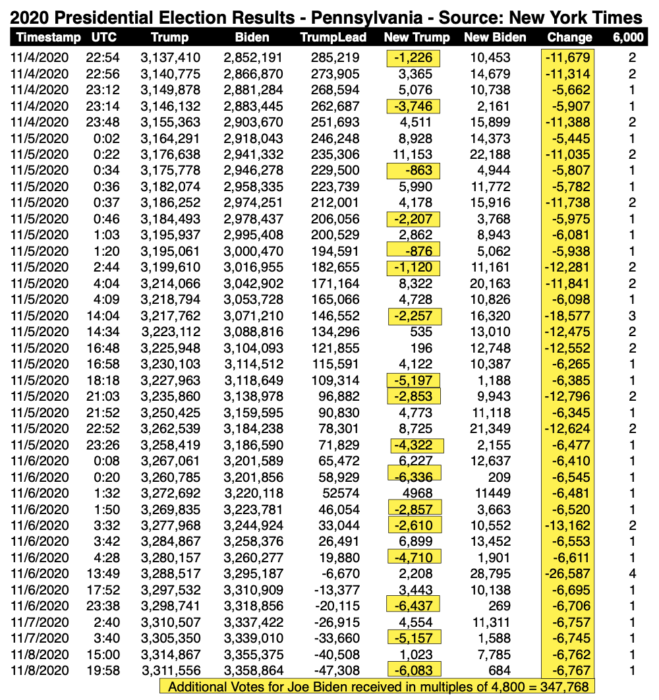
How do votes disappear? The NY Times PA data timeline shows Trump losing votes. But the Times says do not believe your lying eyes; there was no election fraud. A statistical analysis of New York Times data in Philadelphia claims a suspicious string of voting “ratios” benefiting Biden, as also happened in Georgia.
By 11pm Election Day, Trump was leading Biden by about 285,000 votes. Then, 347,768 votes from somewhere dumped into the system in 44 batches in increments of approximately 6,000, 12,000, or 18,000 additional net votes for Biden. As a result, Biden came back from an election night deficit of 285,000 to a 46,000 vote win four days later. https://centralcitynews.us/wp-content/uploads/2020/11/Central-City-News-11-19-20-Small.pdf
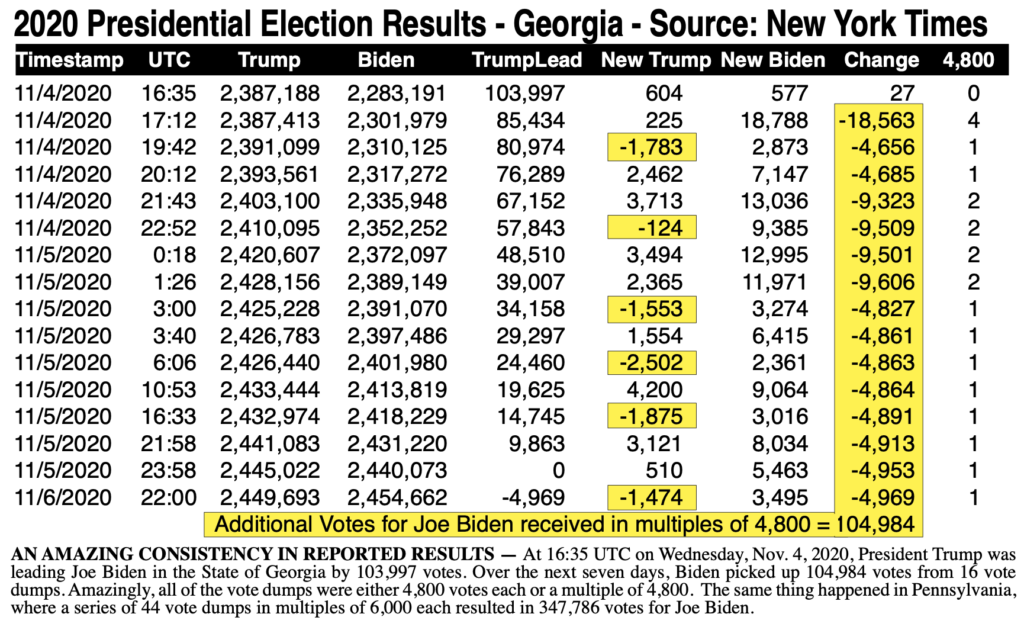
The NY Times GA data timeline also shows Trump losing votes. But the Times says do not believe your lying eyes; there was no election fraud. Statistical analysis shows Biden pulling from behind in improbably consistent increments in Georgia and other states.
“On Wednesday, Nov. 4, the New York Times reported President Trump was leading in Georgia by 103,997 votes. Then the Times’ continuous voting updates showed ballots arriving for Biden in multiples of 4,800 votes over and over again. In some vote dumps, the President actually lost votes.” This continued until Biden pulled ahead by almost exactly 1,000 votes, gaining 104,984 votes in multiples of 4,800.
This third installment of Navarro’s report provides investigators with up-to-date statistical “receipts” and a well-documented tally of potentially illegal votes on a state-by-state and category-by-category basis. Source: NavarroReport.com:
Volume 3 provides a scholarly rendering of the potential number of illegal votes in the 2020 election. Peter Navarro welcomes anyone who wishes to dispute its findings “because that is the nature of scholarly discourse.”
Note: The above table does not include 1) estimated 2.5% machine vote flipping from Trump to Biden, 2) Dr. Epstein’s estimate that 6-10% of Trump voters flipped to Biden from the propaganda effect of Google algorithms which favored Biden, and 3) a survey which found that 7% of Biden voters would have voted for Trump if they knew about the Biden scandals.
The corrupt MSM, Dems and Repubs will say they don’t see anything suspicious in the graph and that we should not believe our lying eyes. What is the probability of a 150,000 vote spike for the Dems 10 minutes after stopping the count? Looks like the PA election late night vote dump, but on a smaller scale.
Deaths from other causes are included in the COVID-19 total…
“When Briand looked at the 2020 data during that seasonal period, COVID-19-related deaths exceeded deaths from heart diseases. This was highly unusual since heart disease has always prevailed as the leading cause of deaths. However, when taking a closer look at the death numbers, she noted something strange.
As Briand compared the number of deaths per cause during that period in 2020 to 2018, she noticed that instead of the expected drastic increase across all causes, there was a significant decrease in deaths due to heart disease. Even more surprising, as seen in the graph below, this sudden decline in deaths is observed for all other causes.
This trend is completely contrary to the pattern observed in all previous years. Interestingly, as depicted in the table below, the total decrease in deaths by other causes almost exactly equals the increase in deaths by COVID-19. This suggests, according to Briand, that the COVID-19 death toll is misleading. Briand believes that deaths due to heart diseases, respiratory diseases, influenza and pneumonia may instead be recategorized as being due to COVID-19″ . https://archive.is/DJdin
The conventional wisdom is that a presidential candidate could win the popular vote and lose the electoral vote – or vice versa. This is extremely unlikely in a fair election; there is virtually a 100% probability that the winner of the popular vote would win the electoral vote. But all elections are fraudulent to some extent.
The Democrats want to get rid of the electoral college and replace it with the winner of the popular vote, thinking this would help them win elections in the future. But this is based on the premise that they can more easily win or steal the popular vote, like they have done in the last two elections. Consider the 2000, 2004, 2016 and 2020 elections, all of which were fraudulent.
Bush stole the 2000 election. He won the Electoral vote by 271-267. Gore won the recorded popular vote by 540,000 and the true vote by at least 5 million. He led the unadjusted exit polls in 11 states but lost them all in the vote. If he had won just one, he would have won the election.
Bush stole the 2004 election. He won the bogus recorded popular vote by 3 million and the electoral vote by 286-252.. But Kerry won the true popular vote and the unadjusted exit polls by at least 7 million. He had approximately 349 electoral votes.
Clinton tried to steal the 2016 election. She won the bogus recorded vote by 3 million. But Trump won the electoral vote by 306-232 as well as the true popular vote.
Biden stole the 2020 election, the most fraudulent in history. He won the bogus recorded vote by 7 million and the electoral vote 306-232. But Trump won the true popular vote by 15-18 million with 356-393 electoral votes.
We are constantly fed propaganda by the media and politicians that Clinton won the popular vote by 2.8 million.But the NEP How Voted 2016 demographic indicates that 43% voted for Trump and 40% for Clinton.Trump had a much bigger margin in 2020 than he did in 2016. Election fraud in 2020 is massive. Biden won the bogus reported vote by 80.7-74.6 million (51.0-47.1%).But Trump won the election in a landslide. This should be obvious to anyone who looks at the overwhelming evidence of fraud.The 2020 National Exit Poll (NEP) forced a match to the fraudulent reported vote. The focus is on two demographics: returning 2016 voters and party affiliation.
In the 2016-1 analysis, the 2016 reported vote (Clinton by 48.2-46.1%) is assumed as the basis for voter turnout in 2020. Trump wins by 6.1 million votes (50.6-48.4%).In 2016-2, returning voters are based on the 2020 NEP (Trump by 43-40%).Trump wins by 12.0 million votes (53.2-44.8%). In both cases, equal turnout rates of Trump and Clinton voters is assumed. This is conservative. Historically, Republicans turn out at higher rates than Democrats.
2020 NEP
Mix
Biden
Trump
Other
Clinton
40%
95%
4%
1%
Trump
43%
7%
92%
1%
Other
5%
60%
25%
15%
DNV (new)
12%
58%
39%
3%
Calculated
100.0%
51.0%
47.1%
1.9%
Vote (mil)
158.38
82.08
75.13
1.17
Margin
6.95
Recorded
100.0%
51.3%
46.9%
1.8%
Vote
158.38
81.27
74.22
2.90
2016-1
Mix
Biden
Trump
Other
Clinton
44.4%
90%
7%
3%
Trump
42.5%
2%
96%
2%
Other
5.2%
37%
55%
8%
DNV (new)
7.9%
48%
52%
0%
Calculated
100.0%
46.5%
50.9%
2.6%
Vote (mil)
142.0
66.1
72.2
3.7
Margin
6.1
2016-2
Mix
Biden
Trump
Other
Clinton
38.8%
90%
8%
2%
Trump
41.4%
2%
96%
2%
Other
4.2%
37%
55%
8%
DNV (new)
15.6%
48%
52%
0%
Calculated
100.0%
44.8%
53.2%
1.9%
Vote (mil)
142.0
63.6
75.6
2.8
Margin
12.0
2020 NEP
Voted 2016
Clinton
Trump
Other
DNV
National
40%
43%
5%
12%
FL
38%
44%
5%
13%
PA
41%
44%
4%
11%
OH
36%
46%
5%
13%
GA
38%
40%
5%
17%
MN
39%
41%
8%
12%
WI
39%
42%
7%
12%
MI
40%
42%
4%
14%
AVG
38.7%
42.7%
5.4%
13.1%
In the Sensitivity analysis of 25 scenarios: Trump has 92-96% share of returning Trump voters and 6-10% of Clinton voters. His vote margins range from 5.1 (worst case) to 14.2 million (best case).
Trump %
Other 55%
DNV 52%
%Clinton
6%
7%
8%
9%
10%
% Trump
Trump
96%
52.5%
52.9%
53.2%
53.6%
54.0%
95%
52.1%
52.4%
52.8%
53.2%
53.6%
94%
51.6%
52.0%
52.4%
52.8%
53.2%
93%
51.2%
51.6%
52.0%
52.4%
52.8%
92%
50.8%
51.2%
51.6%
52.0%
52.4%
Biden
96%
45.6%
45.2%
44.8%
44.4%
44.0%
95%
46.0%
45.6%
45.2%
44.8%
44.5%
94%
46.4%
46.0%
45.6%
45.3%
44.9%
93%
46.8%
46.4%
46.1%
45.7%
45.3%
92%
47.2%
46.9%
46.5%
46.1%
45.7%
Margin
96%
6.9%
7.6%
8.4%
9.2%
10.0%
95%
6.0%
6.8%
7.6%
8.4%
9.1%
94%
5.2%
6.0%
6.8%
7.5%
8.3%
93%
4.4%
5.2%
5.9%
6.7%
7.5%
92%
3.6%
4.3%
5.1%
5.9%
6.7%
Margin
96%
9.8
10.9
12.0
13.1
14.2
95%
8.6
9.7
10.8
11.9
13.0
94%
7.4
8.5
9.6
10.7
11.8
93%
6.2
7.3
8.4
9.5
10.6
92%
5.1
6.2
7.3
8.4
9.5
In the Party-ID demographic, Democrats comprised 37% and Republicans 36%. Biden won 94% of Democrats and 6% of Republicans, Trump won 94% of Republicans and just 5% of Democrats. But Biden led Independents by 54-41%, giving him a 7.5 million vote margin (51.5-46.8%). In the adjusted calculation, I use the latest Gallup voter affiliation weights (31D-31R-28I) and estimate that Trump had 52% of Independents and won by 6.8 million votes (50.6-47.1%).
There was a constant 4.1% discrepancy in Trumps symposium vs. reported votes in nearly all states. This indicates that the Cyber electronic vote counts likely used the same algorithm. The Cyber vote does not include stuffed ballots after closing (see “2000 Mules”) and other fraud factors, so that Trump may have won by nearly 14 million votes.
“On August 11, 2020 Mike Lindell counted off most every State with their true election results after the electronic fraud has been removed. All 50 States were affected by the hacking of our voting systems. He used the actual packet captures to obtain the results. He also stated, the 74,000,000 votes for Biden may have an additional 16,000,000 removed by forensic audits for what will be determined to be human fraud. All 50 States were affected to some degree. This must be addressed by Americans who seek the truth”.
CNN misleads on Biden Approval (49%). But it is just 34% based on their own internal polling numbers (calculations below). Of course, do you really expect the truth from the MSM?
“The 12/16 poll finds roughly two-thirds (66%) have doubts and reservations about Biden’s leadership, including 92% of Republicans, 75% of independents and 36% of Democrats. Still, Biden’s overall approval holds about even at 49% approve to 51% disapprove. Those approval ratings are similar to recent polls from AP-NORC and Reuters/Ipsos”.
But the ratings conflict with the actual poll calculation which shows that Biden has 34% approval. And this assumes that Biden’s vote shares are legitimate and were not inflated. If they were, his True approval is even lower than 34%. Biden has 33% approval if the 2020 National Exit poll party-ID weights are used.
View the Reuters poll below: Biden 48% approve; 46% disapprove? Sure, and I have a bridge in Brooklyn for you. But at least Reuters bogus Party-ID and vote shares agree with the rating.
The Civiqs poll (36% approval) makes sense. It agrees with the 34.8% calculation using NEP weights.
Biden approval 1
CNN
Approve
Disapprove
Democrat
36%
64%
36%
Republican
28%
8%
92%
Independent
36%
25%
75%
CALCULATED
100%
34%
66%
Biden Approval 2
NEP
Approve
Disapprove
Democrat
36%
64%
36%
Republican
36%
8%
92%
Independent
28%
25%
75%
CALCULATED
100%
33%
67%
Sensitivity Analysis – Biden total approval for 15 scenarios: 60,64,68% Democratic approval, 19,23,27% Independent and 8% Republican
The single 2020 election anomaly that proves fraud.
In Georgia, 96,800 ballots were cast for just the president and no other office on the ballot. A total of 96,000 voted just for Biden and 800 just for Trump. What is the probability of such a wide difference? We would expect approximately 48,000 for each. It is just as likely for a Biden voter to do this as it is for a Trump voter.
In Georgia, Biden won 99% of ballots that only voted for President and no other races. The number of votes: Trump: 818; Biden: 95,801.
Calc 1: binomial distribution function: P = BINOMDIST(8,968,0.5,true) P = 7.51E-273 (0)
Calc 2: factorial function (!): For example, 8! = 8*7*6*5*4*3*2*1. P = 968!/(8!*960!)*(0.5^8)*(0.5^960) P = (0.5^8)*(0.5^960) P = 0.5^968 P= 4.01E-292 =0
The Public Interest Legal Foundation (PILF) said on Friday that 82,766 mail ballots sent to voters in Wisconsin’s November 2020 presidential election “went missing or undeliverable,” a number more than four times greater than Joe Biden’s 20,682 vote certified margin of victory in the state.
”The report showed that, unlike the results of the 2012 and 2016 elections, the number of “missing or undeliverable” mail ballots in 2020 exceeded the margin of victory for the state’s ten electoral college votes.
In 2016, 158,846 ballots were mailed to Wisconsin voters, just 11 percent of the 1.4 million votes cast in that election. Of these ballots, 11,138 were classified as “unknown” and 1,846 were “undeliverable.” Combining the two classifications, the 12,984 mail ballots were only 47 percent of Donald Trump’s certified 27,257 vote margin of victory in WI over Hillary Clinton.
In 2020, 1.4 million ballots were mailed to Wisconsin voters (86 percent of the 1.6 million mail in votes cast). Nationwide, of 90.6 million ballots sent, 1.1 million were undeliverable, 560,814 rejected and 14.7 million “unknown”.
PILF President J. Christian Adams: “These figures detail how the 2020 push to mail voting needs to be a one-year experiment. Bills like H.R. 1/S.1 risk inflating these numbers even further, pushing our election system toward error, disenfranchisement and ultimately widespread doubt about election outcomes. Some of the counties with the least experience in administering mail voting rejected the most ballots nationwide. If continued, 2020-style chaos will become the norm”.
Biden “won” Wisconsin by 20,682 votes, but Trump led by 127,000 votes (52.4-47.6%)with just 701,000 (18%) of 3.3 million remaining to be counted. The probability that Biden would tie Trump by winning 59.1% of the remaining votes when he had just 47.6% of the votes counted is
P= 1 in 15,421 (assuming a 1.0% MoE): P=normdist(E30,0.5,0.01/1.96, false)

 Richard Charnin's Blog